Posts

Showing posts with the label Cotton for Good

Data, trust, and traceability: how the U.S. Cotton Trust Protocol is reshaping the cotton supply chain.

Image
In today’s fashion and textile industries , the demand for transparency is becoming increasingly important. Stakeholders are more invested in supply chains, demanding verifiable proof of sustainable and responsible practices . Leading the way is the U.S. Cotton Trust Protocol , the sustainability program for U.S.cotton growers and traceability platform for all U.S. Cotton. Through six years of increasing grower enrollment, new global brand and retailer members, and a robust data-driven framework, the program is helping to build a more resilient and responsible cotton supply chain.  The foundation of any agricultural sustainability program lies with its growers. Despite a challenging growing environment in the 2023/2024 crop year, the Trust Protocol achieved its sixth consecutive yearof record growth , with a 14% increase in grower enrollment and an 18% increase in planted acres. So, what is driving this momentum? The benefits for growers are tangible and multifaceted. They rec...

Beyond the label: cotton traceability from fiber forward.

Image
  On World Cotton Day , we celebrate not only the “fiber that clothes the world”, but also the people and processes that shape its journey from seed to shelf. Every claim about sustainable cotton, whether organic, regenerative, or lowcarbon, starts with a single question: where did this cotton come from? Unfortunately, the answer isn’t always clear. Cotton often changes hands multiple times before it is spun into yarn, woven into fabric, or stitched into a final garment. In many supply chains, growers are abstracted from the process, and their commendable practices at the start of the journey deserve to be carried all the way to the shelf, ensuring every claim is backed by proof and every story stays intact. The only way to achieve this is to start with the fiber and the farmer. Scientific traceability methods such as stable isotope analysis can verify the geographic origin of cotton at the fiber, yarn, and greige fabric stages. By establishing forensic baselines for specific growi...

Starting with farmers, let us regenerate our soil and protect our future.

Image
It has been six years since the first World Cotton Day , which is celebrated every 7 October . The event was not created by clothing brands or fashion enthusiasts. It was brought to life by the World Trade Organisation upon the request of four  African cotton-producing nations – Benin,Burkina Faso, Chad, and Mali – to recognise and celebrate their work. World Cotton Day started with farmers. While this is always a special date for the team at the Better Cotton Initiative(BCI) , as we take stock of progress and look to the future, this year feels even more momentous, as it also marks 20 years since the inception of our organisation. In 2005, a WWF-led multistakeholder roundtable met to discuss the future of sustainability in our sector, and the Better Cotton Initiative was born. Fast forward two decades and BCI now manages a global field-level standard, tailoring its programmes to support the needs of specific farming communities across 15 countries, and accounting for nearly a q...

Almost 70% of clothing is made from plastic.

Image
 The EU prepares to implement its Digital Product Passport, tighten green claims regulations, and finalise labelling rules, the stakes remain high. Without decisive improvements, cotton risks being locked into a system that undervalues its benefits -and the world risks doubling down on fossil fuel-based textiles .  Why we must build on this momentum? The campaign has achieved a great deal, but the work is far from done. For cotton , advocating for a fair and credible PEF, is not just a technical detail - it is a defining issue for market access and consumer perception. Labels influence purchasing decisions, and regulations shape Cotton supply chains . If environmental scoring systems remain flawed, they could accelerate the trend toward synthetics at a time when the fashion industry urgently needs renewable,circular, and biodegradable fibres.  A call to action  As we celebrate World Cotton Day 2025 under the banner of “ Cotton for Good ”, we must remember that goo...

Focus on the incredible benefits of cotton.

Image
    World Cotton Day is a precious opportunity to educate the world about the incredible benefits cotton provides to us all on a daily basis. Here’s why this natural fiber deserves the spotlight: • Poverty Alleviation : Cotton is a lifeline for millions, particularly in developing countries. Every tonne of cotton provides full-time, year-round employment for five people, offering critical job prospects in regions where such opportunities are often scarce. • Women’s Empowerment : Remarkably, 43% of cotton farmers worldwide are women. Cotton farming not only provides income but also fosters gender equality by empowering women with greater autonomy and decision-making power in their communities. • Biodegradability : In a world drowning in plastic pollution, cotton stands out as a sustainable alternative. Unlike synthetic fibers that can take centuries to decompose, cotton biodegrades in weeks to months. • Carbon Sequestration : Cotton cultivation has great potential to play...

Cotton for Good: celebrating Cotton and its global impact.

Image
Every year on October 7th , the world comes together to celebrate a natural fiber that has shaped economies, empowered communities, and championed sustainability: cotton . Since its establishment in 2019, World Cotton Day has grown into a global event, shining a spotlight on the vital role cotton plays in our lives and the planet’s future . With the theme “ Cotton for Good ,” this annual celebration is a call to action to recognize cotton’s contributions and confront the challenges it faces . A Day of Global Recognition The idea for World Cotton Day was first conceived at the International Cotton Advisory Committee (ICAC) in 2018. The following year, the WTO hosted the inaugural event with help from the Food and Agriculture Organization (FAO) , Internationa Trade Centre (ITC) , and United Nations, Conference on Trade and Development (UNCTAD) , United Nations Industrial Development Organization (UNIDO) , and the ICAC. Since then, the International Atomic Energy Agency (IAEA) has joi...

Explore how best to bolster cotton's impact and value.

Image
In recent years, the United Nations officially recognized October 7th as World Cotton Day ,  a day to spotlight the cotton sector and its reach across economies and livelihoods worldwide . This year's theme, "Cotton for Good", celebrates the myriad benefits associated with the fibre as well as the need to invest in sustaining cotton's future . Today, the focus is on Benin, where Better Cotton representatives will be among the 400 attendees convening in Cotonou to explore how best to bolster cotton's impact and value . Benin is especially significant as it recently became the latest country to have a Better Cotton Programme launched. Together with Mozambique, Egypt, Mali and Côte d'Ivoire, our programmes in Africa will play an instrumental role in transitioning toward a more sustainable cotton future across the continent . As we continue to build relationships in cotton-farming communities of all scales , we are taking a moment amid WCD 2024 to reflect on s...

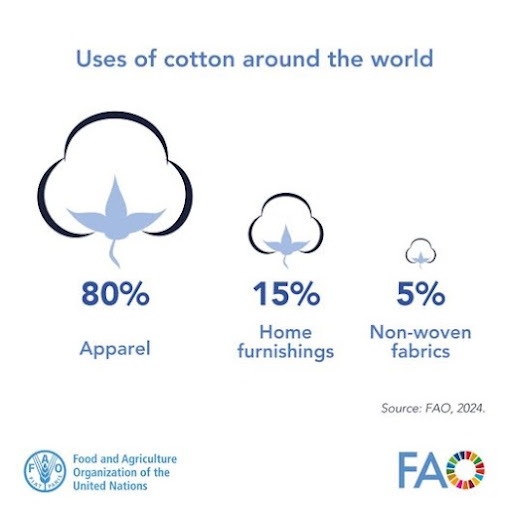
Use of cotton around the world.

Image
  Did you know? Around 80% of cotton is used in apparel 15 % in home furnishings 5% accounts for non-woven applications, such as filters or padding