Posts

Showing posts with the label Cotton

Making the label count for cotton: why accurate sustainability metrics matter.

Image
Cotton is one of the world’s most important natural fibres - renewable, biodegradable, and vital for the livelihoods of millions of farmers. Yet today, the way its sustainability is measured could define its future. Increasingly, global textile markets are shaped not just by fashion trends, but by environmental labelling systems intended to inform consumer choices. Among these, the European Union’s Product Environmental Footprint (PEF) methodology has emerged as a frontrunner, designed to underpin future product labelling and green claims. But behind the promise of transparency lies a critical challenge: current environmental impact models often fail to reflect the true benefits of natural fibres like cotton . The risk? Simplified scoring systems may unintentionally favour synthetic fibres - oil-based and persistent in nature - over fibres that are renewable and biodegradable. For cotton , this could have far-reaching implications for demand, market access, and its role in deliveri...

Focus on the incredible benefits of cotton.

Image
    World Cotton Day is a precious opportunity to educate the world about the incredible benefits cotton provides to us all on a daily basis. Here’s why this natural fiber deserves the spotlight: • Poverty Alleviation : Cotton is a lifeline for millions, particularly in developing countries. Every tonne of cotton provides full-time, year-round employment for five people, offering critical job prospects in regions where such opportunities are often scarce. • Women’s Empowerment : Remarkably, 43% of cotton farmers worldwide are women. Cotton farming not only provides income but also fosters gender equality by empowering women with greater autonomy and decision-making power in their communities. • Biodegradability : In a world drowning in plastic pollution, cotton stands out as a sustainable alternative. Unlike synthetic fibers that can take centuries to decompose, cotton biodegrades in weeks to months. • Carbon Sequestration : Cotton cultivation has great potential to play...

Explore how best to bolster cotton's impact and value.

Image
In recent years, the United Nations officially recognized October 7th as World Cotton Day ,  a day to spotlight the cotton sector and its reach across economies and livelihoods worldwide . This year's theme, "Cotton for Good", celebrates the myriad benefits associated with the fibre as well as the need to invest in sustaining cotton's future . Today, the focus is on Benin, where Better Cotton representatives will be among the 400 attendees convening in Cotonou to explore how best to bolster cotton's impact and value . Benin is especially significant as it recently became the latest country to have a Better Cotton Programme launched. Together with Mozambique, Egypt, Mali and Côte d'Ivoire, our programmes in Africa will play an instrumental role in transitioning toward a more sustainable cotton future across the continent . As we continue to build relationships in cotton-farming communities of all scales , we are taking a moment amid WCD 2024 to reflect on s...

Global 2024/25 Cotton Production Forecast Higher.

Image
Global cotton production in 2024/25 is projected at 117.6 million bales, about 3.5 percent (4.1 million bales) above the previous year and 2 percent above the 5-year average (figure 6). For 2024/25, cotton production prospects for most of the major-producing countries are projected to increase. Year-over-year gains in the United States and Brazil were largely responsible for the global increase, offset slightly by declines in India and Pakistan. World 2024/25 cotton harvested area is forecast at 31.5 million hectares (77.8 million acres), less than 1 percent above the previous year. The 2024/25 global cotton yield is forecast at 813 kilograms (kg) per hectare (725 pounds per acre), 3 percent above the 3-year average and a record high. World cotton production is concentrated among a few countries, with the top four countries accounting for 71 percent of total expected production in 2024/25, the same as the previous season. China and India are expected to remain the leading cotton produ...

World 2024/25 Cotton Mill Use Projected To Rise Modestly.

Image
  Global cotton mill use in 2024/25 is projected at 116.2 million bales, nearly 3.5 percent above 2023/24’s revised estimate of 112.4 million bales and its highest in 4 years. Stable global economic growth expectations and lower cotton fiber prices compared with a year ago are projected to support increased world cotton mill use in 2024/25. Cotton mill use in China—the leading cotton spinner —is projected at 38.0 million bales in 2024/25, 500,000 bales (1 percent) above the previous year. China is forecast to account for 33 percent of global cotton mill use in 2024/25. Mill use in India is projected to increase 2 percent (500,000 bales) to 25.5 million bales as rising product exports support the mill use gain .  India is expected to account for 22 percent of the world mill use total in 2024/25. Pakistan’s 2024/25 cotton mill use is forecast at 9.6 million bales, 2 percent above the year before as larger supplies are available to local textile mills. Higher cotton mill use in...

Historical Adjustments to China’s Cotton Supply and Demand Estimates Lead to Lower 2023/24 Beginning Stocks.

Image
Cotton estimates for China play a major role in the global supply and demand outlook . China is by far the single largest cotton spinning country —contributing one-third of global cotton mill use—and is the largest stockholder—accounting for nearly half of the world’s surplus stocks each year. China is also among the leading cotton producing and importing countrie s. China’s prominence in the global cotton market emphasizes the importance of USDA’s China cotton supply and demand projections , with back-year estimate adjustments sometimes deemed necessary after reexamining historical data or considering additional information. The August 2024 revisions to China’s supply and demand balance sheet for 2015/16–2022/23 are a reevaluation of previous production, use, and stocks data. During the 8-year period, China’s cotton area and production outside of Xinjiang declined due to subsidy policy changes and decreased faster than previously estimated. The non-Xinjiang revisions led to a cumula...

Use of cotton around the world.

Image
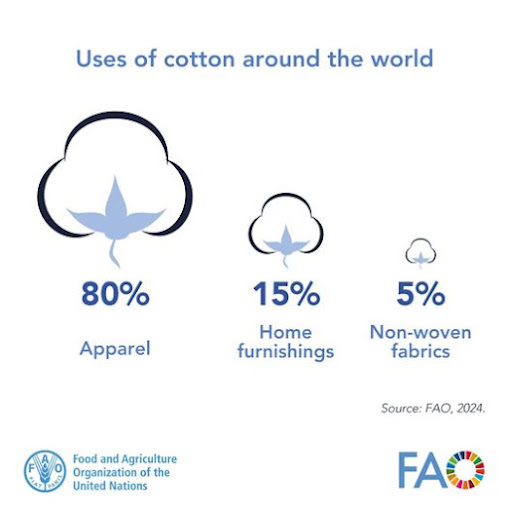
  Did you know? Around 80% of cotton is used in apparel 15 % in home furnishings 5% accounts for non-woven applications, such as filters or padding