Posts

A call to renew global commitments to a fair, inclusive, and sustainable cotton sector.

Image
C4+ Countries will celebrate artisanal traditions, market opportunities, and youth engagement in building a vibrant, locally driven cotton industry . These sessions will emphasize how value addition, local manufacturing, and cultural heritage can strengthen resilience and sustainability across the cotton supply chain . World Cotton Da y is a call to renew global commitments to a fair, inclusive, and sustainable cotton sector . By addressing pressing challenges such as competition from synthetic fibers , changing weather patterns, and shifting consumer demand , the event aims to chart a path toward greater efficiency, resilience, and opportunity . With millions of people and their families depending on cotton for their livelihoods, the day serves as a reminder that this natural fiber is not only a cornerstone of global trade but also, truly, “ The fabric of our lives .” A Call to Action Despite its many benefits, cotton faces significant challenges. The rise of synthetic fibers, fuel...

The basis of sustainable cotton schemes.

Image
What is ‘sustainable’? We all think we know it, instinctively, because it is part of our modern lexicon. But do we? It can be even more confusing when mentioning the term ‘regenerative’. How do we then dig down to defining sustainable agriculture? Sustainable cotton? Does sustainable cotton exist in a vacuum as a single crop? Or does it need to be sustainable in a wider farming, processing and rights system that covers labour, women’s, and human rights? All standards do have some common foundations – and all interpret them, which explains why there are many standards, and why there can be major differences in focus and adoption of elements between them, defined by practicalities, as well as geography. The principles come from theories, including agroecology, which will sometimes cover non-production related items as well as farming. But Integrated Pest Management (IPM) focuses specifically on the agricultural and ecosystem elements. Regenerative, coming in many shapes and forms, can va...

Explore how best to bolster cotton's impact and value.

Image
In recent years, the United Nations officially recognized October 7th as World Cotton Day ,  a day to spotlight the cotton sector and its reach across economies and livelihoods worldwide . This year's theme, "Cotton for Good", celebrates the myriad benefits associated with the fibre as well as the need to invest in sustaining cotton's future . Today, the focus is on Benin, where Better Cotton representatives will be among the 400 attendees convening in Cotonou to explore how best to bolster cotton's impact and value . Benin is especially significant as it recently became the latest country to have a Better Cotton Programme launched. Together with Mozambique, Egypt, Mali and Côte d'Ivoire, our programmes in Africa will play an instrumental role in transitioning toward a more sustainable cotton future across the continent . As we continue to build relationships in cotton-farming communities of all scales , we are taking a moment amid WCD 2024 to reflect on s...

U.S. Cotton Crop Forecast Reduced but Highest in 3 Years.

Image
Thee USDA’s first survey-based estimate of the 2024/25 U.S. cotton crop is 15.1 million bales. Although 11 percent below last month’s projection, the estimate is 25 percent above last season’s final estimate of 12.1 million bales. The 2024 cotton planted area estimate of nearly 11.2 million acres is based on all available data, including the latest certified acreage from the Farm Service Agency. This season’s cotton planted area is 9 percent above 2023/24, as cotton prices heading into planting season were more favorable relative to other crops. With improved moisture conditions compared with a year ago across much of Texas—the largest cotton-producing State—the early-season U.S. abandonment projection is reduced compared with last year. A U.S. abandonment rate of 23 percent projected for 2024/25 is below the year before and less than half the 47 percent record for 2022/23. U.S. cotton harvested acreage is forecast at 8.6 million acres, the highest in 3 years. The U.S. cotton y...

U.S. Cotton Demand and Stock Estimates Revised.

Image
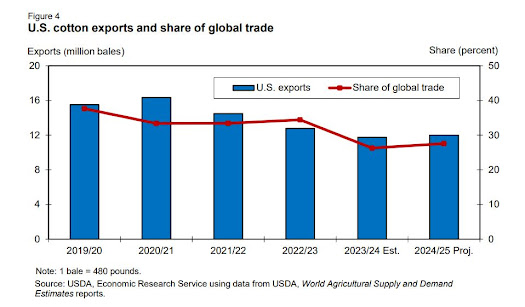
  U.S. cotton demand (mill use plus exports) and stocks for 2024/25 and 2023/24 were adjusted in August based on the latest available data. U.S. exports for 2024/25 are forecast at 12.0 million bales, 1.0 million below the July projection but slightly above the previous year (figure 4). The lower forecast is attributable to the reduced crop estimate this month as well as decreased import prospects from China, a major destination for U.S. cotton. U.S. cotton mill use is projected at 1.9 million bales in 2024/25, unchanged from July but slightly above last year. The U.S. export estimate for 2023/24 was increased this month to 11.75 million bales, the lowest since the 2015/16 shipments of 9.2 million bales. Complete data for 2023/24 U.S. cotton exports will be available in September. Estimated U.S. cotton mill use remains at 1.85 million bales in 2023/24. The United States is expected to be the second largest cotton exporter to the world in 2024/25. Lower U.S. production, associated ...

U.S. Cotton Product Trade Slightly Lower in First Half of 2024.

Image
  Total U.S. cotton textile and apparel trade declined during the first half of 2024, compared with the corresponding 2023 period. U.S. cotton product imports totaled the equivalent of 7.2 million 480-pound bales of raw cotton during January–June 2024 compared with 7.4 million bales during the first 6 months of 2023, a 3-percent decline. Cotton product exports decreased 5 percent to approximately 1.2 million bale-equivalents. As a result, the cotton textile and apparel trade deficit fell about 2.5 percent during the first half of 2024, reaching 6.1 million bale equivalents. U.S. cotton product imports are sourced from many countries, although most products are imported from a handful of suppliers. During the first half of 2024, the top five countries contributed 68 percent of total U.S. cotton product imports , slightly above the corresponding period in 2023. Although the total share is similar, changes are notable for a couple of countries, indicating the vitality of each countr...

Global 2024/25 Cotton Production Forecast Higher.

Image
Global cotton production in 2024/25 is projected at 117.6 million bales, about 3.5 percent (4.1 million bales) above the previous year and 2 percent above the 5-year average (figure 6). For 2024/25, cotton production prospects for most of the major-producing countries are projected to increase. Year-over-year gains in the United States and Brazil were largely responsible for the global increase, offset slightly by declines in India and Pakistan. World 2024/25 cotton harvested area is forecast at 31.5 million hectares (77.8 million acres), less than 1 percent above the previous year. The 2024/25 global cotton yield is forecast at 813 kilograms (kg) per hectare (725 pounds per acre), 3 percent above the 3-year average and a record high. World cotton production is concentrated among a few countries, with the top four countries accounting for 71 percent of total expected production in 2024/25, the same as the previous season. China and India are expected to remain the leading cotton produ...